
Semi-absentee franchise opportunities let an owner lead through a trained manager, operating systems, and regular performance oversight. The owner is not the full-time day-to-day operator. For a mobile dog grooming investor, the important question is simple. Do the people, systems, economics, and support structure make delegated ownership realistic?
What Does Semi-Absentee Mean in the Franchise World?
Semi-absentee ownership means the franchise owner remains accountable for the business while a manager or operations leader handles much of the daily execution. The owner may keep a career, operate another business, or focus on strategy, but the business is not a hands-off investment. The owner still makes important decisions, reviews results, develops the team, and protects the customer experience.
The U.S. Small Business Administration describes this model as a franchise structured to have a supervisor in place from the beginning, rather than one that requires the owner to operate every function personally. The SBA also cautions that many franchise opportunities still require substantial owner involvement, so buyers should investigate the actual operating design instead of relying on a label. Read the SBA’s overview of semi-absentee franchise opportunities.
Semi-absentee is not passive ownership
A passive investment is expected to operate without regular owner judgment. A semi-absentee franchise is different. The owner delegates tasks, not responsibility. That means you may still oversee hiring decisions, approve spending, review customer feedback, coach the manager, monitor safety, and respond when a key employee leaves.
- Owner-operator: You are the primary daily operator and often perform or supervise front-line work.
- Semi-absentee owner: You lead the manager, review performance, and make decisions that cannot be delegated.
- Passive investor: You expect little or no regular involvement. That is not the promise a responsible franchise buyer should assume.
The right comparison is not working versus not working. It is front-line execution versus business leadership. A good semi-absentee model moves your work upward into planning, people management, financial review, and accountability.
| Ownership model. | Primary daily role. | Owner accountability. |
|---|---|---|
| Owner-operator. | Leads front-line work and daily execution. | Directly manages service and business decisions. |
| Semi-absentee. | Manager leads daily execution. | Reviews performance, develops leaders, and makes strategic decisions. |
| Passive investor. | Expects little daily involvement. | Should not be assumed from a franchise label or brochure. |
How Can You Evaluate Whether a Franchise Is Truly Semi-Absentee Ready?
A franchise is truly semi-absentee ready when its staffing model, training, technology, reporting, and franchisor support allow an owner to supervise a capable operator without being needed for every daily decision. The strongest evaluation looks for evidence in the operating system, not lifestyle language in a brochure.
1. Define the owner’s role in practical terms
Ask the franchisor to describe your first year in a normal week. Who opens and closes the operation? Who handles schedule changes? Who manages customer escalations? Who recruits, trains, and evaluates employees? Which decisions require the owner’s approval?
Also ask how the role changes as the business matures. Some models are owner-operated during launch and can support an Operations Manager pathway after the team, customer base, and routines are established. That can still be a strong semi-absentee opportunity, but it is different from a model that expects a manager to run the business from day one.
2. Test the manager model
The manager is the operating bridge between the owner and the customer. A credible opportunity should explain the manager’s responsibilities, authority, training, reporting cadence, and performance expectations. You should understand how the business recruits this person, what happens when the manager is unavailable, and how the owner steps in without becoming the permanent replacement.
Do not evaluate the manager role as an expense alone. Evaluate it as the structure that makes delegation possible. If the role has unclear authority, weak training, or no backup plan, the owner may end up doing the job personally.
3. Look for visibility without micromanagement
Delegated ownership only works when the owner can see what is happening. Request examples of the reports, dashboards, meetings, and key performance indicators franchisees use. Useful visibility may include booked appointments, route efficiency, customer retention, labor coverage, safety incidents, equipment status, cash flow, and customer feedback.
The goal is not to create a dashboard full of numbers. The goal is to create a decision rhythm. A manager should know what to act on today. An owner should know what requires coaching, investment, or a change in direction this week.
4. Validate with current franchise owners
Ask current franchise owners what they actually do each week, how involved they were during launch, and how often they have needed to cover a staffing gap. Ask whether the franchisor’s training prepared them to hire and manage people, not just to learn the service. Ask for examples of support during a difficult customer issue or a manager transition.
These conversations are part of mutual evaluation. They help you learn whether the opportunity fits your preferred level of involvement. Kontota encourages candidates to review the current FDD, speak with franchise owners, and use the discovery process to make an informed decision without pressure.
What Systems and Staff Are Needed to Operate Without Daily Owner Involvement?
Operating without daily owner presence requires more than a job title. It requires repeatable workflows that a trained manager and team can follow, measure, and improve. In mobile dog grooming, the system must coordinate people, vans, appointments, customer communication, pet safety, and territory coverage.
People systems
- Clear roles: Separate the owner’s strategic responsibilities from the manager’s daily responsibilities and the groomer’s service responsibilities.
- Hiring standards: Define what good performance looks like before recruiting. A franchise owner does not need to be a professional groomer, but does need to build and lead the team that delivers the service.
- Training and coaching: Give managers and groomers a consistent way to learn procedures, customer service, safety standards, scheduling, and quality control.
- Coverage plans: Identify who handles operations when the manager is sick, leaves, or needs support during a busy period.
Operating systems
- Scheduling and routing: Use a consistent process for placing appointments, reducing avoidable travel, and communicating changes.
- Van and equipment routines: Track maintenance, inventory, sanitation, and readiness so a single equipment problem does not become a customer experience problem.
- Safety procedures: Make safety a non-negotiable operating standard for pets, customers, groomers, and vehicles.
- Customer recovery: Define who responds to complaints, when the owner is notified, and how the team documents the resolution.
- Financial controls: Review sales, expenses, payroll, and cash needs on a set cadence rather than waiting for a surprise.
Kontota’s franchise training and support program covers business systems such as hiring and human resources, customer acquisition, scheduling, safety management, quality control, grooming training processes, and business and office systems. Those capabilities matter to a semi-absentee owner because they turn an individual employee’s knowledge into a repeatable operating method.
How Semi-Absentee Franchise Opportunities Can Work for Mobile Grooming Owners
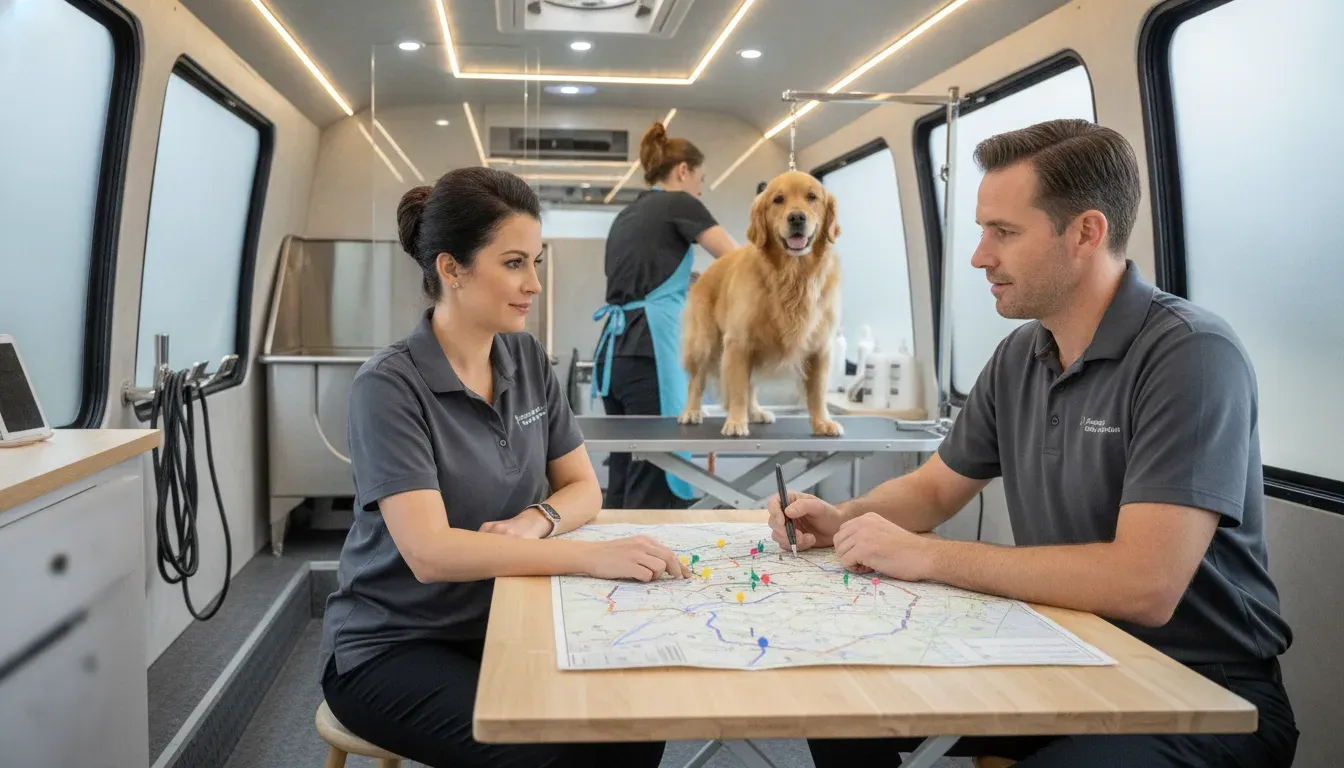
Mobile dog grooming can fit semi-absentee ownership because the business is organized around scheduled appointments, trained service professionals, route management, and a defined local territory. The owner does not need to perform every grooming appointment to lead the business. The owner does need to build a team that can deliver safe, consistent service from the van.
The model also creates a visible operating unit. A van, a route, a schedule, a groomer, and a customer relationship can each be reviewed as part of a broader system. That structure can help an owner identify bottlenecks and coach the manager without standing at the grooming table all day.
The owner still builds the business
Semi-absentee does not remove the owner’s most important work. During launch and growth, the owner may need to recruit leaders, establish local relationships, review marketing, support hiring, approve investments, and make decisions about adding vans or territories. The Operations Manager pathway is an option for delegating daily operations, not a promise that the owner can ignore the business.
Kontota’s home-based model, protected territory approach, technology focus, and ongoing franchise support are designed for owners who want to operate a business rather than become the only person who can make it function. Candidates do not need to know every technical detail before joining. They do need the willingness to learn the system, lead people, and develop the business.
Demand does not replace execution
Pet ownership creates a broad market, but market demand alone does not make an investment work. A local operation still needs appropriate territory planning, reliable staffing, safe service delivery, route discipline, and customer retention. A semi-absentee owner should ask how the franchisor supports those activities and how results are measured.
What Should You Budget Before Choosing a Semi-Absentee Franchise?
A semi-absentee buyer must budget for both the franchise investment and the management structure that makes delegated ownership possible. Review the current FDD for complete terms, assumptions, and disclosures. For Kontota, current approved investment information includes an initial franchise fee of $42,000 and an estimated total initial investment of $95,000 to $153,500. The current model also lists a 7% royalty fee and a $100 monthly technology fee. These figures are not earnings projections or guarantees.
Start with a practical question: can I afford the franchise fee? Then ask whether the business can support the people and systems required for the way I want to own it. Budget for startup funding, working capital, manager compensation, hiring time, training, marketing, van readiness, and the possibility that launch will require more owner attention than the mature operation.
Use Kontota’s dog grooming franchise cost, investment, and ROI guide as a starting point for investment questions. The semi-absentee decision should add a second layer: whether the operating plan is financially and practically prepared for an owner who leads through a manager.
What Mistakes Do Semi-Absentee Franchise Owners Make?
The most common mistakes come from treating semi-absentee as an escape from management. A manager can run daily operations, but the owner is still responsible for creating the conditions in which that manager can succeed.
- Choosing the label instead of the operating model: Ask for the weekly responsibilities, reporting cadence, and launch expectations in writing.
- Underestimating the launch phase: A new territory needs attention while hiring, training, scheduling, and customer acquisition routines are being built.
- Hiring a manager without defining authority: A manager who cannot make routine decisions will send every issue back to the owner.
- Measuring revenue alone: Review service quality, staffing, safety, route efficiency, customer retention, and cash flow alongside sales.
- Failing to plan for turnover: Build a recruiting pipeline and a coverage plan before a manager or groomer leaves.
- Ignoring the FDD and franchisee validation: Read the current disclosure document and speak with franchise owners before making a commitment.
A strong owner does not disappear after hiring a manager. A strong owner creates clarity, checks the right signals, develops leaders, and intervenes early when the business needs help.
Is a Semi-Absentee Mobile Dog Grooming Franchise Right for You?
A semi-absentee mobile dog grooming franchise may fit an investor who wants to build and manage a local service business without being the primary groomer. The fit is strongest when you are comfortable with hiring, financial review, manager coaching, customer accountability, and strategic decisions. It is weaker when you want a completely hands-off investment or do not have time to respond when the business needs leadership.
Use this short screen before your discovery call:
- Do I want to lead a business, or am I only looking for passive income?
- Can I commit the time and attention required during launch and staffing changes?
- Am I prepared to recruit, coach, and hold an Operations Manager accountable?
- Will I review the FDD and ask current franchise owners direct questions?
- Do the investment, working capital, territory, and growth assumptions fit my plan?
Kontota’s franchise process is a mutual evaluation that includes a Discovery Call, Territory Analysis, FDD Review, Franchise Validation and Headquarters Meeting, and Franchise Agreement Signature. There is no need to decide before you understand the business model and your role in it.
Frequently Asked Questions
What is a semi-absentee franchise opportunity?
A semi-absentee franchise opportunity is designed for an owner to lead through a manager and operating systems instead of performing every daily task personally. The owner remains accountable for people, finances, standards, and strategic decisions. It is an active ownership model, not a promise of completely passive income.
Can I own a mobile dog grooming franchise without grooming experience?
Yes, Kontota positions its franchise model for owners who do not have professional grooming experience. Franchise owners can hire trained groomers and focus on operating and developing the business. They still need to learn the operating system, lead the team, and protect safety and service standards.
Does semi-absentee mean I can keep my current job?
A semi-absentee model may allow an owner to keep another job or business, but the actual time commitment depends on the franchise, the manager, the market, and the stage of the business. Ask the franchisor and current owners what the first year requires and what happens during staffing or customer issues.
What should I ask a franchisor about its Operations Manager pathway?
Ask when owners typically use the pathway, what the manager owns, what the franchisee still approves, how managers are trained, and how performance is reported. Also ask how the business handles manager turnover and whether current owners can describe the role from direct experience.
How much does a Kontota mobile dog grooming franchise cost?
Kontota currently lists a $42,000 initial franchise fee and an estimated total initial investment of $95,000 to $153,500. The current FDD contains the complete terms, assumptions, and disclosures. Candidates should also budget for working capital and the management structure needed for their preferred ownership model.
What is the first step to evaluate a semi-absentee franchise?
Start with a discovery call that focuses on fit, owner responsibilities, territory, staffing, training, support, and investment. Then review the current FDD and speak with franchise owners before making a decision. A thoughtful process helps you evaluate the actual business model rather than a marketing label.

